

 Assessment training Airbus A320
An APS-MCC is not about learning to fly one specific aircraft type. It is not a type rating. The goal is to prepare pilots for working in a professional airline cockpit: collaborating as a crew, communicating under pressure, applying procedures, and making decisions in an operational environment.
However, the simulator you train on does matter. That is why SimFlying deliberately chooses an Airbus A320 simulator. We explain why in this blog.
A realistic airline environment
An APS-MCC can be taught on a generic multi-crew simulator. This allows you to effectively train the basic principles of cooperation, communication, and division of tasks. However, a generic cockpit often remains somewhat more abstract.
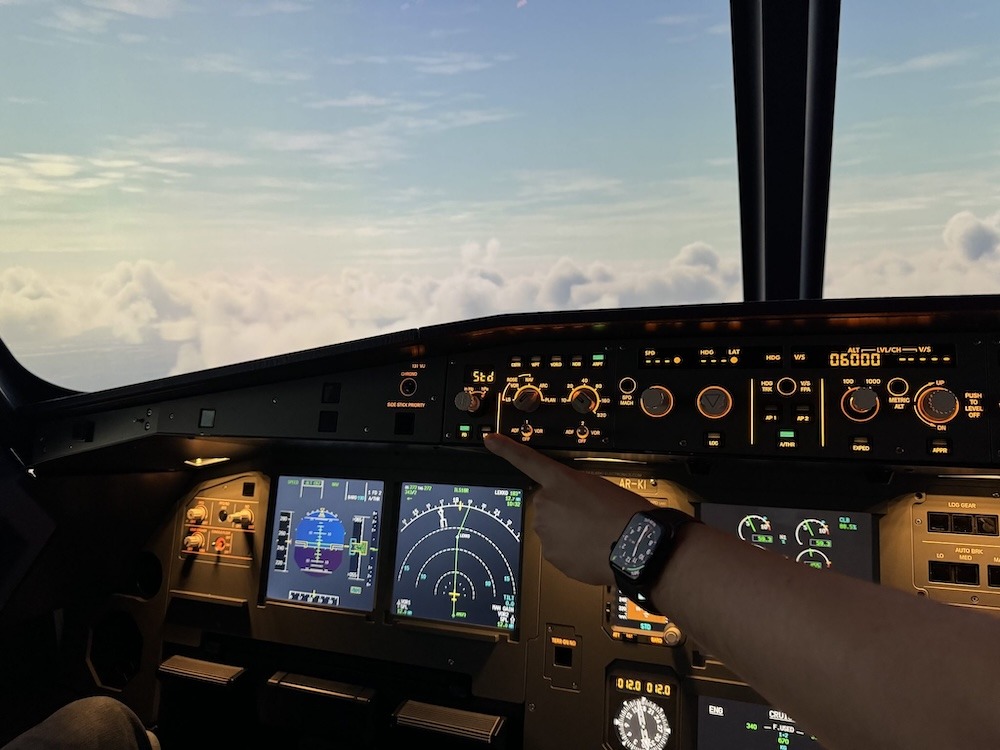
At SimFlying, we want to train candidates in an environment that is closer to real-world practice. A cockpit where SOPs, automation, briefings, call-outs, flight management, and crew coordination come together, just as they do in airline operations. The A320 offers a familiar and modern environment for this. Candidates not only train on the principle of multi-crew cooperation but also experience what that looks like within a realistic jet cockpit.
Alignment with the Dutch market
For Dutch pilots, the choice of an A320 simulator is particularly relevant. Transavia started its fleet renewal some time ago and has already put many Airbus A321neos into service. KLM also joined the A320neo family with its European fleet in recent years, and will soon do so with the Airbus A350 on long-haul routes. As a result, Airbus is becoming an increasingly important part of the Dutch airline market.
For future pilots, this means a greater chance that they will encounter Airbus procedures, cockpit logic, and operational methods during their further training, selection, or career.
Not a type rating, but better preparation
An APS-MCC on the A320 does not make you an A320 pilot yet. A separate type rating is required for that later. However, training on a familiar simulator does help to make the step to the next phase easier. Candidates become familiar with a modern cockpit environment, automation, SOP thinking, and the division of roles between Pilot Flying and Pilot Monitoring. This is valuable, regardless of whether you eventually end up on an Airbus, Boeing, Embraer, or another type. After all, the core remains the same: functioning professionally in a multi-crew airline environment.
Advantages over a generic simulator
A generic MCC simulator can be perfectly suitable for training basic principles. However, an A320 platform offers a number of clear advantages for candidates who want to prepare for airline operations.
1. Greater resonance with practice
You train in a cockpit environment similar to what you might encounter later at an airline.
2. Better alignment with selections and follow-up training
Many airline selections and training revolve around SOP usage, CRM, TEM, call-outs, workload management, and decision-making. A realistic cockpit makes those skills more concrete and recognizable.
3. Less abstract scenarios
An engine failure, abnormal procedure, or high-workload approach feels more realistic when you work with a recognizable cockpit layout, automation principles, and task allocation.
4. Relevance to the Dutch and European market
With the fleet renewal at KLM and Transavia, among others, the Airbus A320neo family is becoming increasingly visible among Dutch and European airlines.
Preparing for the cockpit you are growing into
The step from flight school to an airline cockpit is a big one. You move from relatively small-scale flying to an environment where procedures, collaboration, automation, and operational pressure come together. That is precisely why we believe it is important that an APS-MCC does not feel too theoretical or generic. Candidates need to learn what multi-crew collaboration looks like in practice. The A320 is a strong simulator for this. Not because it concerns Airbus itself, but because it aligns with the way many modern airlines operate and the direction in which the Dutch market is developing.
APS-MCC on the Airbus A320 at SimFlying
Starting in the summer of 2026, SimFlying will offer a full APS-MCC on the Airbus A320 simulator. Our training is aimed at pilots who want to prepare for the move to an airline. During the self-study, ground school, and simulator sessions, topics covered include CRM, TEM, SOPs, communication, automation management, and decision-making.
The choice of the A320 makes the training more concrete and market-oriented. Candidates train in a recognizable airline environment, with instructors who know the field and can translate that into what is expected of you later in the cockpit.
Would you like to know more about our APS-MCC? Then check out the information on our website.